
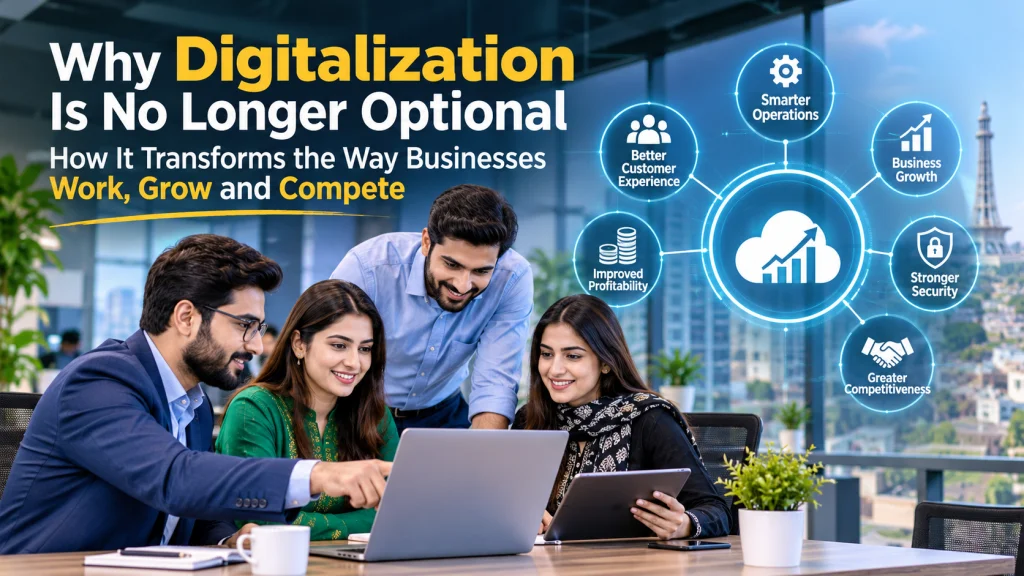
Introduction: Business Is Changing, and So Are the Rules of Success
Think about how people discover businesses today. Before visiting a shop, contacting a service provider, or making a purchase, most customers do something remarkably simple: they search online.
They compare prices, read reviews, explore websites, check social media pages, and sometimes make their purchasing decisions without ever speaking to a representative.
Now consider the business on the other side of that experience.
A company that still depends entirely on paperwork, manual record-keeping, traditional advertising, and disconnected communication methods may find it increasingly difficult to meet modern customer expectations.
This is where digitalization comes in.
Digitalization is no longer just about having a website, creating social media accounts, or introducing a few software applications into the workplace. It is about improving the way an entire business operates by using digital technology to make everyday processes faster, smarter, more accessible, and more efficient.
Whether you operate a small retail store in Lahore, manage a manufacturing company in Karachi, run a consultancy in Islamabad, or lead an established organization in another part of the world, digital transformation can fundamentally change how you serve customers and manage your business.
But why has it become so important, and what practical difference can it actually make?
Let’s explore.
1. Digitalization Helps Businesses Work Smarter, Not Just Harder
Running a business involves countless repetitive activities. Employees prepare reports, respond to customer inquiries, update records, manage inventory, process orders, coordinate departments, and handle administrative responsibilities.
When these activities are performed manually, they consume valuable time and create opportunities for mistakes.
Digital tools can simplify many of these processes.
For example, instead of maintaining customer information in multiple spreadsheets, a business can use a customer relationship management (CRM) system. Rather than preparing every invoice manually, accounting software can automate billing, payment tracking, and financial reporting.
Similarly, project management platforms help teams monitor deadlines, assign responsibilities, and track progress without endless email exchanges.
The real benefit is not simply completing tasks faster. It is giving employees more time to focus on activities that actually contribute to business growth.
A business that spends less time managing paperwork has more time to improve its products, serve customers, develop new ideas, and explore opportunities.
For small and medium-sized businesses, especially those operating with limited staff, this can make a significant difference.
2. Customers Expect Businesses to Be Available Online
Customer behaviour has changed dramatically.
People no longer want to wait until business hours to find basic information. They expect to discover services, check prices, ask questions, book appointments, and sometimes complete purchases whenever it is convenient for them.
Imagine someone looking for an accounting firm in Lahore. They search Google, visit a few websites, compare services, check customer reviews, and contact the company that appears most reliable.
If your business has no meaningful online presence, that potential customer may never know you exist.
This is why having a professional website and an active digital presence matters.
A well-developed business website can provide:
- Information about your products and services.
- Contact details and business locations.
- Customer testimonials and reviews.
- Online inquiry and appointment forms.
- Product catalogues and pricing information.
- Helpful articles and educational resources.
- Online purchasing or booking facilities.
Businesses can also use platforms such as Google Business Profile to improve their visibility in local search results.
For companies targeting customers in Lahore, Karachi, Islamabad, Faisalabad, or other Pakistani cities, local search visibility can be particularly valuable.
When someone searches for a service near them, a properly optimized online presence increases the opportunity for your business to appear in front of people who are already interested in what you offer.
Being online does not guarantee customers, but being invisible online can mean missing opportunities.
3. Better Customer Experience Creates Stronger Business Relationships
Winning a customer is important. Keeping that customer is often even more valuable.
Modern consumers appreciate businesses that make their lives easier. They want quick responses, accurate information, convenient payment options, transparent communication, and reliable after-sales support.
Digitalization makes these experiences easier to deliver.
Consider a customer who purchases a product online. They receive an automatic order confirmation, payment receipt, delivery update, and notification when the product is dispatched.
They do not need to repeatedly contact the company to find out what is happening.
Likewise, a service-based business can use automated appointment reminders, digital forms, and customer support systems to reduce unnecessary delays.
Even a simple WhatsApp Business setup can improve communication by providing business information, product catalogues, quick replies, and automated greetings.
These improvements may seem small individually, but together they create a smoother customer journey.
And when customers have a positive experience, they are more likely to return, recommend your business, and leave positive reviews.
Digital transformation is therefore not only about internal operations. It is also about building customer trust through convenience and consistency.
4. Automation Reduces Repetitive Work and Human Errors
One of the most practical reasons to invest in digitalization is automation.
Many businesses still spend hours performing tasks that software could handle automatically.
For instance:
- Sending payment reminders.
- Generating invoices.
- Updating inventory records.
- Confirming customer appointments.
- Sending order notifications.
- Recording employee attendance.
- Preparing routine reports.
- Organizing incoming customer inquiries.
Automation allows these processes to happen with minimal manual involvement.
Suppose a company receives 100 customer inquiries every week. If employees spend five minutes organizing and responding to each inquiry, that represents more than eight hours of work.
A structured CRM system with automated lead assignment, response templates, and follow-up reminders can reduce much of that administrative burden.
This does not mean removing human involvement from business operations. It means allowing people to concentrate on decisions, relationships, and problem-solving instead of repeatedly completing the same administrative tasks.
It also reduces the risk of forgotten follow-ups, incorrect entries, misplaced documents, and inconsistent processes.
For growing companies, automation provides a way to manage increasing workloads without necessarily increasing administrative costs at the same rate.
5. Digitalization Helps Businesses Make Better Decisions
Every business generates information.
Sales figures, customer preferences, website visits, advertising performance, inventory movements, employee productivity, and financial records all contain useful insights.
The challenge is knowing how to interpret that information.
Traditional reporting methods can make it difficult to identify patterns, especially when information is scattered across different departments.
Digital business management systems bring important information together and make it easier to understand.
For example, a retail business can use sales analytics to identify its best-selling products, busiest purchasing periods, and slow-moving inventory.
An e-commerce company can examine website analytics to understand where visitors come from, which products receive the most attention, and where potential customers abandon their shopping carts.
A marketing team can compare campaign performance to determine which advertising channels generate meaningful inquiries rather than simply attracting clicks.
This is the difference between making decisions based on assumptions and making decisions based on evidence.
Data-driven decision-making does not eliminate uncertainty, but it gives business owners a much clearer picture of what is happening.
Instead of asking, “Why are sales decreasing?” management can begin investigating specific figures, customer behaviour, market trends, and operational performance.
That insight can lead to better planning, more effective spending, and smarter business strategies.
6. Digital Marketing Helps Businesses Reach the Right Audience
Traditional marketing still has its place, but digital marketing offers something particularly valuable: the ability to reach specific audiences and measure results.
A business can invest in search engine optimization (SEO), social media marketing, Google Ads, email campaigns, and content marketing to connect with people who are actively looking for relevant products or services.
Consider a construction company operating in Lahore.
Instead of relying entirely on referrals and conventional advertising, it can publish useful information about construction planning, renovation costs, architectural design, and project management.
By optimizing this content for relevant search queries, the company can attract people researching construction services in its target locations.
Similarly, a clothing brand in Pakistan can use social media content, product photography, influencer collaborations, and an e-commerce website to reach customers beyond its immediate neighbourhood.
The important advantage is measurability.
Businesses can track website traffic, advertising costs, conversion rates, customer inquiries, and sales generated through different channels.
This helps them understand what works and where their marketing budget should go.
Digital marketing is not about being present on every platform. It is about identifying where your potential customers spend their time and creating useful, relevant experiences for them.
7. Digitalization Makes Business Growth More Scalable
Growth sounds exciting until a business starts struggling to manage it.
More customers mean more orders, more communication, more records, more employees, and more operational responsibilities.
Without organized systems, growth can create confusion rather than profitability.
Imagine a small company processing 20 orders per day manually. The same approach may become difficult when the company begins receiving 200 orders daily.
Digital systems help businesses prepare for that increase.
An integrated inventory management system can track stock levels across locations. Accounting software can organize financial transactions. CRM platforms can manage thousands of customer records. Cloud-based collaboration tools can help employees work together even when they are in different cities.
This is particularly useful for businesses expanding from one location to multiple branches.
A company based in Lahore can coordinate operations with teams in Islamabad, Karachi, Multan, or international markets using centralized systems.
Instead of depending on physical documents and constant phone calls, employees can access updated information through authorized digital platforms.
The result is a more organized business that can expand without rebuilding its entire operational structure every time it grows.
8. Remote Work and Digital Collaboration Have Changed the Workplace
The modern workplace is no longer limited to a traditional office.
Many organizations now operate through a combination of office-based employees, remote teams, field representatives, freelancers, and external service providers.
Digital collaboration makes this possible.
Tools such as Microsoft Teams, Google Workspace, Zoom, and project management platforms allow employees to communicate, share documents, attend meetings, and coordinate tasks from different locations.
For businesses in Pakistan, this can create access to talent beyond their immediate geographical area.
A company in Lahore may work with a designer in Karachi, a developer in Islamabad, and an international marketing consultant without requiring everyone to work from the same office.
It can also reduce unnecessary travel, improve documentation, and make communication more structured.
However, successful remote collaboration requires more than installing software.
Businesses need clear responsibilities, communication policies, access controls, and performance expectations.
Technology creates the opportunity, but good management makes it work.
9. Digitalization Can Improve Financial Control and Reduce Operational Costs
Every business wants to improve profitability. One practical way to achieve this is by understanding where money is being spent and identifying avoidable expenses.
Digital financial systems can make that process considerably easier.
Accounting software helps businesses record transactions, monitor receivables, track expenses, prepare financial statements, and manage invoices.
Inventory systems can reduce unnecessary stock purchases and help identify products that are not selling.
Digital documentation can reduce printing, physical storage, and administrative costs.
Online meetings can minimize travel expenses, while cloud-based software can reduce the need for maintaining expensive on-site infrastructure.
For example, a distributor that has no reliable inventory tracking may repeatedly purchase products it already has in stock. This ties up cash and increases storage costs.
With a digital inventory management system, the business can monitor available stock and make purchasing decisions based on actual requirements.
The savings may not always be dramatic overnight, but consistent improvements across departments can have a meaningful effect on long-term financial performance.
The goal is not to purchase as many digital tools as possible. It is to invest in systems that solve real operational problems and provide measurable value.
10. Cybersecurity and Data Protection Are Now Business Priorities
As businesses become more digital, protecting their information becomes increasingly important.
Customer records, employee information, financial transactions, supplier details, and internal documents are valuable business assets.
If this information is exposed, stolen, or lost, the consequences can include financial damage, operational disruption, legal complications, and a loss of customer trust.
Digital transformation must therefore include cybersecurity from the beginning.
Businesses should consider implementing:
- Strong passwords and multi-factor authentication.
- Regular data backups.
- Updated operating systems and software.
- Access permissions based on employee responsibilities.
- Secure payment processing.
- Employee cybersecurity awareness training.
- Reliable antivirus and endpoint protection.
- Clear data protection and privacy policies.
Small businesses should not assume that cybercriminals only target large organizations.
In fact, smaller companies can be particularly vulnerable when they lack proper security measures.
A secure digital environment helps protect business continuity and strengthens customer confidence.
Digitalization should make a business more efficient, not expose it to unnecessary risks.
11. Digital Transformation Is Important for Every Industry
One common misconception is that digitalization mainly benefits technology companies, online stores, or large corporations.
In reality, almost every industry can benefit from it.
Retail and e-commerce: Digital payment systems, online stores, inventory management, customer databases, and sales analytics can improve the entire purchasing experience.
Healthcare: Appointment booking, electronic records, patient communication systems, and digital administration can make healthcare operations more organized.
Education: Learning management systems, online classes, digital assessments, and student portals can improve access to education and administrative efficiency.
Manufacturing: Production monitoring, automated machinery, quality control systems, and supply chain software can improve operational consistency.
Real estate: Property websites, virtual tours, digital marketing, customer relationship management, and online inquiry systems can help agencies reach potential buyers and tenants.
Professional services: Law firms, accounting companies, consultancies, and agencies can use digital document management, scheduling, billing, and collaboration platforms to improve service delivery.
The technology may differ from one industry to another, but the underlying objective remains the same: making business processes more effective and delivering better value to customers.
12. What Happens to Businesses That Ignore Digitalization?
Not every business needs to adopt every new technology. However, ignoring digital change altogether can create serious disadvantages.
Customer expectations continue to evolve. Competitors are finding new ways to improve efficiency, reduce costs, and reach customers.
A business that depends entirely on outdated systems may eventually struggle with slower operations, inconsistent customer service, limited market visibility, and higher administrative costs.
Consider two companies offering similar services at comparable prices.
The first company relies on manual paperwork, responds to inquiries only during limited hours, and has little online visibility.
The second has a professional website, organized customer management, digital payment options, and an efficient communication system.
Even if both companies offer equally good services, the second may provide a more convenient customer experience.
Over time, convenience, accessibility, and reliability can influence which business customers choose.
Digitalization is therefore not simply about keeping up with competitors. It is about remaining relevant in a marketplace where customer expectations and business practices are constantly changing.
13. How Can a Business Start Its Digital Transformation?
The good news is that digital transformation does not require changing everything at once.
In fact, trying to introduce too many systems simultaneously can create unnecessary confusion.
A better approach is to identify the areas where technology can solve the most immediate problems.
Here is a practical starting point:
Step 1: Review your existing business processes.
Identify repetitive tasks, communication gaps, administrative delays, record-keeping problems, and activities that consume too much time.
Step 2: Establish a professional online presence.
Create a responsive website, update your business information, optimize your Google Business Profile where eligible, and maintain relevant social media channels.
Step 3: Organize customer management.
Introduce a CRM system to maintain customer records, manage inquiries, track sales opportunities, and improve follow-ups.
Step 4: Automate repetitive activities.
Start with simple processes such as invoices, appointment confirmations, email notifications, and routine reporting.
Step 5: Move important records into secure digital systems.
Organize documents, financial records, employee information, and operational data using suitable business software and cloud storage.
Step 6: Train your employees.
Technology is only effective when people understand how to use it. Provide practical training and explain how new systems will improve everyday work.
Step 7: Monitor performance.
Measure improvements in response times, operating costs, customer satisfaction, productivity, and sales performance.
Most importantly, choose technology according to your actual business requirements and budget.
A small business may begin with a website, WhatsApp Business, accounting software, and a simple CRM. A larger organization may need integrated enterprise resource planning (ERP), advanced analytics, and customized automation.
The right solution is the one that addresses your business challenges without creating unnecessary complexity.
Conclusion: Digitalization Is an Investment in the Future of Your Business
Digitalization is not a passing trend or something reserved for companies with large technology budgets.
It is becoming a fundamental part of how successful businesses operate, communicate, compete, and grow.
From improving everyday productivity and customer service to strengthening financial management and expanding market reach, digital technology offers practical benefits across almost every area of business.
But perhaps the most important point is that digital transformation does not have to be complicated.
It can begin with a better website, a more organized customer database, automated invoices, or a simple system for managing daily operations.
What matters is taking the first step and building from there.
For businesses in Pakistan and across the world, the opportunity is significant. Companies that embrace the right digital solutions can create more efficient operations, deliver better customer experiences, and become better prepared for future challenges.
Ultimately, the question is no longer whether digitalization has a place in modern business.
The more important question is whether your business is making the most of the opportunities it offers.
Because in today’s business environment, working hard is important, but working smart, staying connected, and adapting to change can make all the difference.
Frequently Asked Questions (FAQs)
1. Why is digitalization important for businesses today?
Digitalization helps businesses improve operational efficiency, reduce manual work, enhance customer experiences, manage information, and compete more effectively. It also creates opportunities to reach new customers and make better business decisions using data.
2. How does digitalization help small businesses?
Small businesses can use digital tools for marketing, accounting, inventory management, customer communication, online payments, and workflow automation. These solutions help smaller teams manage operations more efficiently without requiring significant increases in staffing.
3. What are the main benefits of digital transformation?
The main benefits include improved productivity, lower operational costs, better customer service, increased market reach, improved data management, stronger collaboration, and more informed decision-making.
4. How can businesses in Pakistan benefit from digitalization?
Businesses in Pakistan can benefit from e-commerce, digital payment solutions, local SEO, online advertising, cloud-based business software, and automated customer management. These technologies can help companies reach customers across Lahore, Karachi, Islamabad, and other cities while improving their internal operations.
5. Is digital transformation expensive?
Not necessarily. Many businesses can start with affordable or free digital tools and gradually invest in more advanced systems as their needs grow. The important consideration is selecting solutions that provide measurable business value.
6. What is the difference between digitization and digitalization?
Digitization means converting physical information into digital formats, such as scanning paper documents. Digitalization involves using digital technology to improve existing business processes, such as managing customer records through a CRM system.
Digital transformation is broader and involves rethinking business operations, strategies, and customer experiences through technology.
7. Which digital tools should a business use first?
A business can begin with a professional website, business email, cloud storage, accounting software, CRM, digital communication tools, and basic analytics. The best starting point depends on its industry, size, budget, and operational challenges.
8. Does every business need digital transformation?
Almost every business can benefit from some level of digitalization. The scale and type of technology will vary, but improving communication, record management, customer service, and operational efficiency is relevant to businesses across industries.
Final Thought: Digitalization is not about replacing the human side of business with technology. It is abo