
The digital world is changing faster than ever, and simply creating good content is no longer enough to guarantee online success. Whether you are running a personal blog, managing a business website, publishing YouTube videos, or building an audience on Facebook, Instagram, TikTok or LinkedIn, getting your content discovered has become one of the biggest challenges for content creators and digital marketers. Millions of blogs, videos, images and social media posts are published every day, but only a small percentage reach the right audience and generate consistent engagement. So, what makes the difference? The answer lies in understanding and implementing three important digital marketing strategies: SEO, GEO and AEO.
These three approaches are becoming increasingly important because people no longer search for information in just one way. Some users type keywords into Google, others ask complete questions through voice search, while many now depend on artificial intelligence tools such as ChatGPT, Gemini and Perplexity to find recommendations, information and solutions. At the same time, social media platforms have developed their own search and recommendation systems, making content discoverability more competitive than ever.
If your content is not optimized for these changing search behaviours, you could be missing valuable opportunities to increase organic traffic, attract new followers, generate leads and build long-term monetization opportunities. Understanding SEO, GEO and AEO together can help your content become more visible across multiple digital platforms.
What Is SEO and Why Is Search Engine Optimization Important?
SEO stands for Search Engine Optimization. It is the process of improving your website, blog articles and online content so that search engines such as Google and Bing can understand, index and display them in relevant search results.
For example, imagine someone searches for “best digital marketing strategies for beginners” on Google. Hundreds or even thousands of websites may have published articles on the same topic. SEO helps search engines identify which pages are relevant, useful, trustworthy and deserving of visibility for that particular search.
Search engine optimization involves several elements, including keyword research, high-quality content, relevant headings, internal linking, external references, website speed, mobile friendliness, technical structure and user experience. However, successful SEO is not simply about inserting popular keywords into every paragraph. It is about understanding what people are searching for and providing genuinely useful answers.
A well-optimized blog post can continue attracting visitors for months or even years after publication. This makes SEO one of the most valuable long-term strategies for generating organic website traffic without depending entirely on paid advertising.
For bloggers, SEO can help articles appear in Google search results. For YouTube creators, relevant keywords in video titles, descriptions and supporting information help communicate what a video is about. For social media creators, searchable captions, relevant phrases, hashtags and descriptive content can improve the chances of discovery within platform search features.
In simple terms, SEO helps your content become discoverable when people actively search for information related to your subject.
What Is GEO and How Does Generative Engine Optimization Work?
GEO stands for Generative Engine Optimization. It is an emerging content optimization approach focused on improving the chances of your content, website or brand being referenced, mentioned or cited in AI-generated answers.
Traditional search engines generally present users with a list of websites and pages. Generative AI platforms, on the other hand, can gather information from multiple sources and produce a conversational response that directly addresses a user’s question.
For example, someone might ask ChatGPT, “What are the best ways to grow a YouTube channel organically?” Instead of displaying only a traditional list of websites, an AI search experience may generate a detailed answer based on information retrieved from different sources.
GEO focuses on making your content useful, understandable, credible and relevant enough to be considered by these generative systems.
This requires a different level of thinking about content creation. Publishing generic articles that repeat information already available across the internet is unlikely to establish a strong competitive advantage. Instead, content creators should focus on original insights, practical examples, accurate information, clear explanations, credible references and demonstrated subject knowledge.
For instance, a blog about digital marketing can become more valuable when it includes real campaign examples, practical SEO recommendations, original observations and measurable results rather than simply repeating commonly known definitions.
The same principle applies to YouTube descriptions and social media content. A descriptive video explanation, accurate captions, a supporting article and consistent brand information can help people and digital systems understand the subject and context of your content.
GEO is particularly important because online discovery is expanding beyond traditional search engines. Users increasingly ask AI assistants for product comparisons, business recommendations, tutorials, educational resources and professional advice.
Being referenced in relevant AI-generated answers can introduce your brand to audiences who might never have discovered your website through a conventional search.
However, GEO does not guarantee that an AI platform will mention or recommend your content. The objective is to build a credible digital presence and publish information that deserves to be discovered and referenced.
What Is AEO and Why Does Answer Engine Optimization Matter?
AEO stands for Answer Engine Optimization. It focuses on structuring content so that search engines, voice assistants and AI-powered answer systems can easily identify and present direct answers to users’ questions.
Think about how people search today. Instead of typing only “YouTube monetization”, someone might ask, “How many views do I need to start earning money on YouTube?” This is a conversational search query, and it requires content that answers the question clearly.
AEO helps make your content suitable for these question-based searches.
One of the most effective ways to implement answer engine optimization is to understand the questions your target audience regularly asks and address them directly within your content. Use meaningful headings, natural language, concise explanations and detailed supporting paragraphs.
For example, an article about website traffic could include a section titled “How Can I Increase Organic Traffic to My Website?” The paragraph immediately following that heading should provide a clear and useful answer before expanding into additional details.
This structure helps readers find information quickly and makes the content easier for search systems to interpret.
Frequently asked questions, step-by-step explanations, informative comparisons and clearly written definitions can also support AEO.
Voice search makes this approach even more relevant. People increasingly use conversational questions when interacting with smartphones, smart speakers and AI assistants. Content that naturally reflects the way people speak and ask questions has a better opportunity to match those searches.
AEO is not about writing short answers and ignoring content quality. It is about making valuable information easy to locate, understand and use.
SEO vs GEO vs AEO: Understanding the Difference
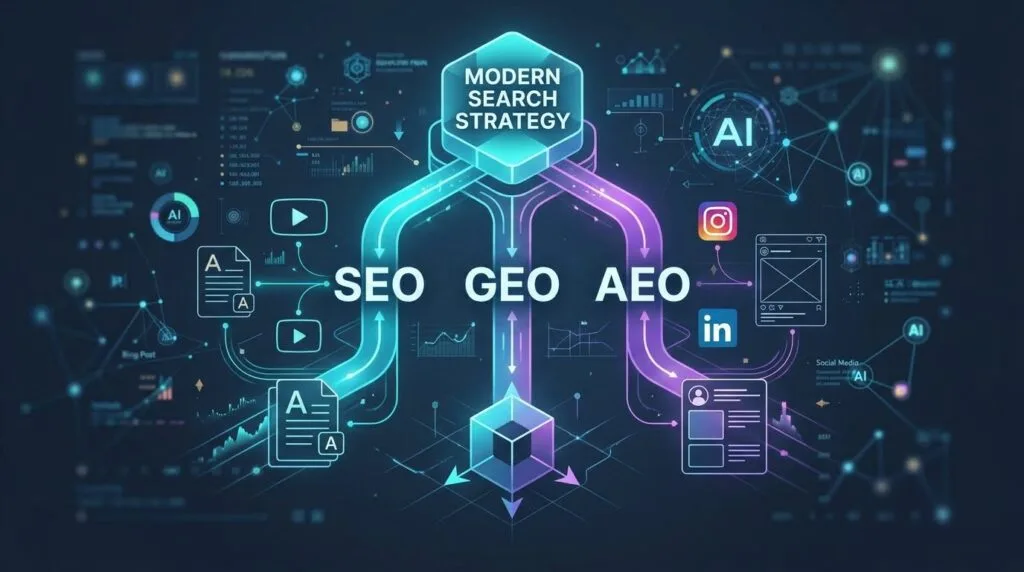
Although SEO, GEO and AEO are closely connected, they serve slightly different purposes.
SEO focuses on helping your content rank in traditional search engine results and attract organic visitors. GEO focuses on improving your visibility within generative AI experiences, where information from multiple sources may be combined into a single response. AEO focuses on making your content suitable for direct answers, question-based searches, featured snippets and conversational search experiences.
Consider a practical example. You publish a detailed article explaining how to start a successful YouTube channel.
With SEO, you optimize the article around relevant search terms such as YouTube channel growth, YouTube SEO tips and how to get more YouTube views.
With AEO, you include clear answers to questions such as how often beginners should upload videos, how to write an effective YouTube description and how YouTube search works.
With GEO, you strengthen the article through original insights, credible sources, practical examples and detailed explanations that make it a valuable reference for AI-powered information systems.
When these strategies work together, your content is prepared for a wider range of discovery opportunities.
It is important to understand that these approaches overlap. They are not three completely separate ranking systems, and no particular SEO, GEO or AEO technique guarantees visibility. Strong, helpful content remains the foundation.
Why SEO, GEO and AEO Should Be Present in Every Blog
A blog is more than a collection of articles. It is a digital asset that can attract visitors, establish authority, generate leads and create revenue over time.
However, even an excellent article cannot deliver its full potential if nobody can find it.
This is why every blog should follow a combined content optimization strategy.
First, keyword research helps identify the actual language people use when searching for information. Understanding search intent allows you to create articles that address specific problems instead of publishing content without a clear audience.
Second, a well-structured article helps both readers and search systems understand the subject. Relevant headings, descriptive paragraphs, internal links and meaningful page titles make navigation easier.
Third, answer-focused content improves the usefulness of an article. When a visitor can quickly find a clear answer to a question, the experience becomes more valuable.
Finally, original information and credible references help establish authority. A blog that consistently publishes reliable and informative content has a stronger foundation for long-term visibility.
For example, a travel blogger writing about the best places to visit in Pakistan should not simply repeat a list of tourist destinations. The article can include transportation information, estimated budgets, travel seasons, personal experiences, accommodation considerations and answers to common questions.
This makes the article more useful to readers and gives search and AI systems more meaningful information to understand.
Why YouTube Videos Need SEO, GEO and AEO
YouTube is one of the world’s largest video discovery platforms, and millions of videos compete for attention every day. Uploading a video is only the beginning. Its title, description, spoken content, captions, thumbnail and overall relevance all contribute to how viewers discover and interact with it.
YouTube SEO starts with understanding what your target audience searches for. A video about cooking, technology, education, entertainment or business should have a title that accurately describes its content and naturally includes relevant search phrases.
The description is equally important. Instead of writing only one or two generic sentences, creators should provide a meaningful explanation of the video, including its main subject, important topics and relevant supporting information.
For example, a video about starting an online business could naturally include phrases such as online business ideas, starting a business from home, digital marketing for beginners and ways to earn online.
AEO can be incorporated by addressing questions within the video and its description. If your video explains how to create a website, make sure the description communicates that information clearly. You can also include useful timestamps and question-based sections when appropriate.
GEO adds another opportunity by encouraging creators to publish informative, trustworthy and original video content. Accurate subtitles and transcripts, detailed explanations and supporting blog articles can provide additional context around the video’s subject.
It is worth remembering that YouTube recommendations are not controlled by keywords alone. Viewer satisfaction, watch time, engagement, relevance and individual viewing behaviour also matter. Optimization can improve discoverability, but it cannot guarantee views.
Creators who combine quality storytelling with thoughtful optimization give their videos more opportunities to reach interested audiences.
How Social Media Platforms Benefit from SEO, GEO and AEO
Social media is no longer just a place to share photographs, entertainment and personal updates. Platforms such as Instagram, Facebook, TikTok, LinkedIn and Pinterest have become important discovery environments where users search for products, services, tutorials, businesses and educational information.
This means that social media content should also be created with discoverability in mind.
On Instagram, descriptive captions, relevant keywords, clear profile information and meaningful hashtags can help communicate the subject of a post or Reel.
On Facebook, informative post descriptions, relevant keywords, page information and useful discussions can improve the clarity and discoverability of content.
On TikTok, spoken words, on-screen text, captions and video descriptions can help the platform understand the topic of a video and match it with relevant viewers.
On LinkedIn, professional terminology, informative posts, subject-specific discussions and detailed explanations can help establish authority within a particular industry.
Pinterest also benefits from descriptive pin titles, relevant keywords and informative descriptions because users frequently search for ideas, products and inspiration.
GEO becomes relevant when your social media content contributes to a broader, consistent online presence. Publishing original insights, sharing useful information and maintaining accurate brand details across different platforms can strengthen your digital footprint.
AEO is equally useful when your posts directly address questions. For example, a short educational Reel explaining “How Does Affiliate Marketing Work?” can attract people interested in learning about that specific topic.
The key is to stop treating social media captions as an afterthought. Every post should communicate its subject clearly and provide value to the intended audience.
How SEO, GEO and AEO Can Increase Views and Monetization
One of the biggest reasons content creators should pay attention to these strategies is their potential impact on audience growth and online income.
More visibility can create more opportunities for people to discover your work. More relevant visitors can lead to increased engagement, subscribers, followers, customers and potential revenue.
For bloggers, increased organic traffic can create opportunities through display advertising, affiliate marketing, sponsored articles, digital products and service inquiries.
For YouTube creators, improved video discoverability can help attract viewers, increase watch time and build a loyal subscriber base. Depending on eligibility and compliance with platform policies, creators may earn through advertising revenue, channel memberships, sponsorships, affiliate links and other monetization features.
For social media creators, better content discovery can help develop an engaged community and attract brand collaborations, product sales, sponsored partnerships and affiliate marketing opportunities.
However, there is an important distinction between views and monetization. Not every view generates revenue, and not every follower becomes a customer. Actual earnings depend on factors such as audience location, content category, advertiser demand, engagement, platform eligibility, monetization policies and the type of revenue model being used.
The real objective should therefore be to attract the right audience rather than simply chase large numbers.
For example, a blog receiving 10,000 highly relevant visitors may generate more valuable business inquiries than another blog receiving 50,000 visitors who have little interest in its subject.
Similarly, a YouTube channel with a smaller but highly engaged audience can sometimes create stronger sponsorship and affiliate opportunities than a channel with significantly more subscribers but limited audience interest.
SEO, GEO and AEO help create the foundation for sustainable visibility. Quality content, audience trust and a clear monetization strategy turn that visibility into business opportunities.
Practical Ways to Implement SEO, GEO and AEO in Your Content
The most effective approach is to integrate all three strategies into your regular content creation process rather than treating them as separate tasks.
Start by researching your audience and identifying the topics, keywords and questions they care about. Use relevant search phrases naturally in titles, introductions, headings, descriptions and captions.
Create content that answers the main question early while providing enough detail to explain the topic properly. Avoid unnecessary repetition and keyword stuffing, as these practices can make content difficult to read.
Develop informative headings that accurately describe each section. Use meaningful internal links in blogs, relevant external references where appropriate, and descriptive metadata.
For GEO, prioritize original information, firsthand experience, credible evidence and consistent brand identity. Explain complicated subjects in accessible language and support important claims with reliable sources.
For AEO, include genuine questions that your audience is likely to ask. Provide direct answers and then expand on them with useful examples, explanations and practical advice.
On YouTube, create accurate titles, detailed descriptions, useful chapters and captions. Make sure your thumbnail represents the actual video and encourages the right audience to watch.
On social platforms, write descriptive captions, use relevant keywords and create content around specific audience interests. Do not copy the same description everywhere without adapting it to the platform and its audience.
Finally, monitor your results. Google Search Console can help website owners understand search impressions, clicks and performance. YouTube Studio provides information about views, watch time, traffic sources and audience retention. Social media analytics can reveal which content generates the strongest reach and engagement.
Use these insights to improve future content instead of relying on assumptions.
The Future of Digital Content Marketing: Why You Cannot Ignore These Three Strategies
The future of online visibility will involve multiple discovery channels working together. Traditional search engines will continue to matter, but AI-powered search, conversational assistants, voice queries and social media discovery are changing how people find information.
Content creators who rely exclusively on traditional keyword placement may miss opportunities to reach audiences through these emerging channels.
At the same time, chasing every new optimization trend without understanding its purpose can waste valuable time and resources. There is no secret formula that guarantees a first-page Google ranking, an AI citation or viral social media reach.
The most sustainable strategy is to create content that genuinely helps people, demonstrates knowledge, answers important questions and is presented in a format that both audiences and digital systems can understand.
Google’s own guidance on generative AI search emphasizes that established SEO foundations, technically accessible websites and unique, people-first content remain important. It also cautions against relying on artificial optimization tricks or unnecessary AI-specific technical requirements.
This is an important reminder that SEO, GEO and AEO should improve the quality and accessibility of your content, not turn it into a collection of keywords written exclusively for algorithms.
Conclusion: Make Every Piece of Content Work Harder for You
Whether you are a blogger, YouTuber, freelancer, business owner, affiliate marketer or social media influencer, SEO, GEO and AEO should be part of your overall content strategy.
SEO helps people discover your content through traditional search engines. GEO creates opportunities for your brand and information to be referenced in generative AI experiences. AEO makes your content easier to understand and use when people search for direct answers.
Together, these approaches can strengthen your online presence, increase opportunities for organic discovery, attract relevant audiences and support long-term monetization.
The most important thing to remember is that publishing more content does not automatically mean achieving more success. Publishing useful, relevant, discoverable and trustworthy content is what creates lasting value.
Every blog article, YouTube video, Instagram Reel, Facebook post and LinkedIn update is an opportunity to connect with someone searching for the information you provide.
Do not simply create content to fill your website or social media calendar. Create content with a purpose, optimize it for the way people search, make it easy for AI systems to understand and give your audience a reason to trust your work.
In the increasingly competitive digital landscape of 2026, visibility is an important part of success. And the creators who understand how SEO, GEO and AEO work together will be better positioned to build an audience, develop authority and turn their digital presence into sustainable growth and monetization opportunities.